

How To Draw A Portrait Of Someone
The Pace-past-Step Guide on How to Draw a Portrait
Past Vladimir London
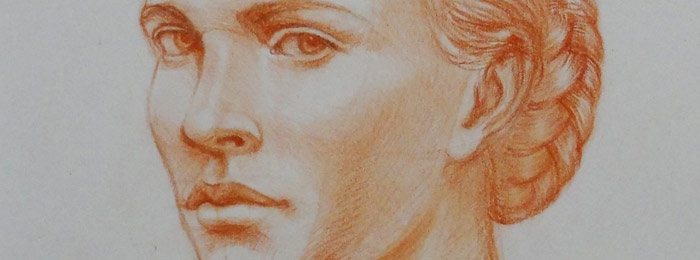
In this book, you will discover the step past footstep procedure of how to draw a head in the 3-quarters view.
It is written and illustrated by Vladimir London, internationally published author and the founder of Drawing Academy.
Preface
In the Drawing Academy course, students ofttimes ask me how to describe a portrait so information technology looks realistic. I besides regularly receive portrait drawings for critique that accept common mistakes similar misplaced facial features, incorrect proportions, wrong perspective, and then on. Such mistakes happen because of:
- Not knowing or non following effective drawing principles
- Ignoring human head proportions
- Cognition gaps in a human being anatomy.
The biggest claiming in cartoon portraits arrives from the misconception of how fine art is created – students draw not what they know, but re-create what they run across. This leads to inevitable mistakes.
To explain why the principle "Draw What Yous Know, not What You See" is of import, I'll give you lot an example. When drawing from life, art students are doing their all-time to depict optics, nose and mouth as they see it on a model, forgetting, all the same, the overall structure of the head. It is like decorating walls before edifice a house.
To "build" a caput in portrait drawing requires much more than than merely copying what you run across. And the necessary know-how only comes with crucial knowledge. You but won't run into the correctness of proportions if you don't know what those proportions are.
So, in this series of articles, I will share with y'all the in-depth step-by-stride know-how of portrait cartoon as information technology's taught in i of the World's best fine art institutions – Repin Academy in St. Petersburg, Russia. This procedure is likewise described in my book "How to Draw a Portrait in the Iii Quarters View" bachelor on Amazon.
Here's how the finishes sketch looks. You volition be able to draw similar portraits by the end of this exercise should you lot follow closely my instructions.
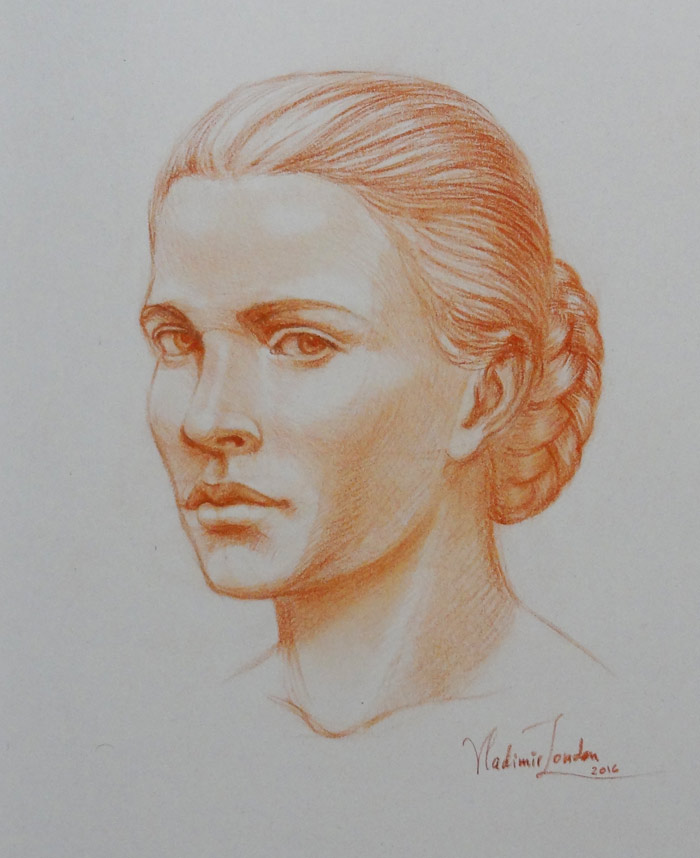
This quick drawing was done in crimson pastel pencil; however, feel gratis to employ any drawing medium of your selection. Information technology is non about color, but constructive drawing principles, rules of perspective, head proportions and anatomy, which won't change whether you describe in graphite pencil, charcoal or with your finger on sand.
How to Draw a Portrait in the Three Quarters View
Before cartoon begins
I would advise getting a model or drawing a cocky-portrait looking in a mirror.
First, analyze the head, chose the view angle, and make up one's mind on the artwork size and layout. Fix paper to a drawing board and get your pencil sharpened.
1. First stride
Brainstorm with measuring the primary proportion of the model's head – its width-to-top ratio using a pencil or past eye. Many fine art students ask me how to measure with a pencil; to answer, I created this commodity – //drawingacademy.com/how-to-measure-with-a-pencil
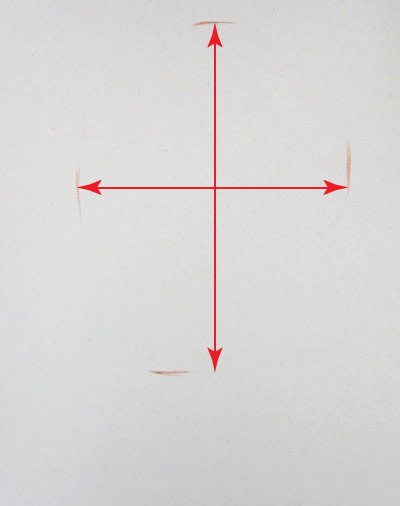 This proportion varies depending on the view angle. Make sure to get it as accurate as you can.
When you have this ratio measured, decide on a composition of your time to come portrait – how big the head would be and where on newspaper information technology will exist located.
Marking four strokes – the top, bottom as well every bit the left and correct edges of the head. Brand certain in that location is plenty space in front of the head – "nose room" and the head is not too shut to the meridian edge of paper. Information technology is likewise good to have more infinite below the head than above.
Train your eyes by marking those edges freehand and, if necessary, double-check the chief proportion using a pencil.
two. Dividing the face into 3 parts
The next step requires a know-how of the universal proportion of the face. All adult faces regardless of individual appearances share the same proportion – the distance between the pilus-root line and the bottom edge of the chin can be divided in three equal parts:
- From the hair-root line to the eyebrow line
- From the countenance line to the base of the olfactory organ
- From the base of the nose to the lesser of the mentum.
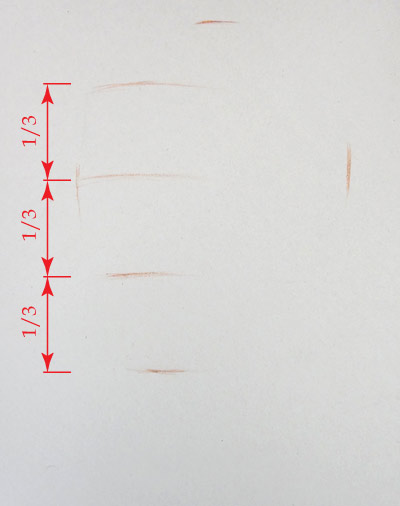 Observe on the model where the hair-root line is intended by nature and marker this line on the drawing. Divide the distance from that line to the bottom of the caput into three equal parts by center or using a pencil every bit a measuring stick. Do information technology as authentic every bit yous tin can; precise location of these three parts will help you in placing facial features correctly.
If the model'due south head is on the same level equally yours, you would see those iii lines horizontal. When the model is located higher than a viewer, lines volition be curved upward. The opposite is also true – lines volition exist curved down when a model's head is located lower. The curvature depends on the view angle.
To go along things uncomplicated for this exercise, nosotros draw a portrait at our eye-level.
3. Placing the center-line
The following pace comes from the know-how – this proportion is not measured on a model's head, it is universal for all portraits – the eye-line divides the superlative of the head in one-half.
So, we can place the eye-line with conviction, marking information technology either freehand or using a pencil to measure where the centre of the head is.
This horizontal line, of course, will be located beneath the eyebrow line that we marked in the previous pace.
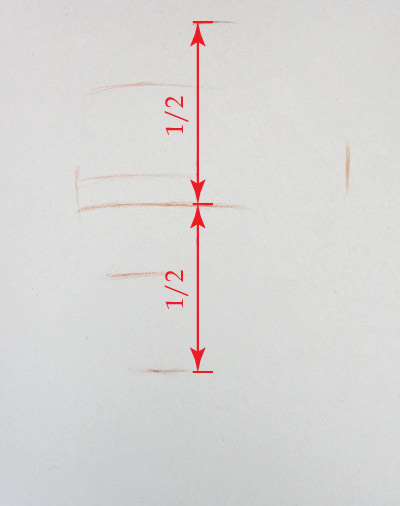 I have to make a disclaimer that the eye-line can exist tilted or curved depending on a view bending. In such case, yous need to keep in mind that distances of this proportion could be foreshortened in perspective and the meridian edge of the caput in your drawing might non stand for to the actual top point of the model'southward head. And then, if we see a head from above, the heart-line would exist curved downwardly and appear lower than the bodily middle point between the top and bottom marks of the caput.
If the paragraph in a higher place sounds a bit confusing, think of a cylinder seen from in a higher place in perspective and imagine how its middle line curves downward and where information technology is located in relation to the cylinder'due south acme and bottom edges. To guide yous through the challenging topic of how to draw in perspective, I created this complimentary video lesson – //drawingacademy.com/drawing-in-perspective
four. Base of the skull and border of the cheekbone
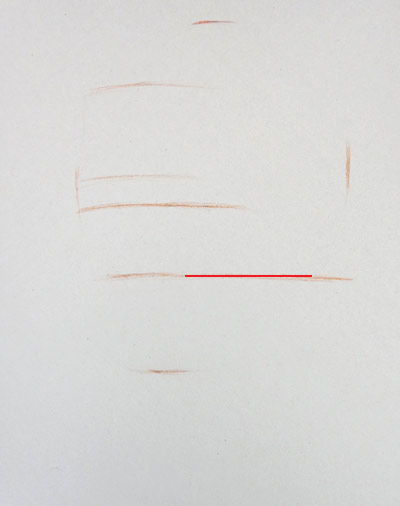 Location the plane of the skull base volition help u.s.a. to connect the head, cervix and shoulders correctly. This airplane is on the same level as the base of the olfactory organ, which also corresponds to the bottom edge of the cheekbone. This level is marked in cherry line.
five. Lower part of the cranium
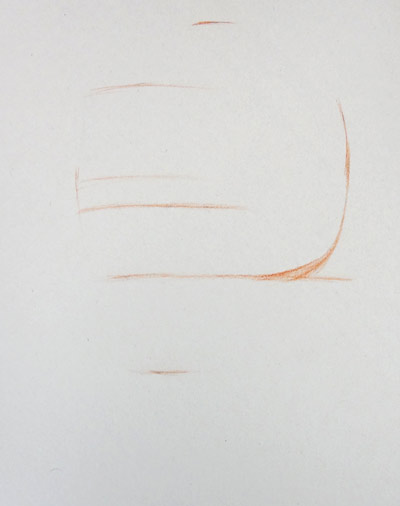 In this step nosotros marker the location of the lower function of the cranium. Although it might exist hidden past long hairs or a alpine collar we do information technology using i of the constructive drawing principles – drawing objects equally if they are transparent.
6. Locating the eyebrow
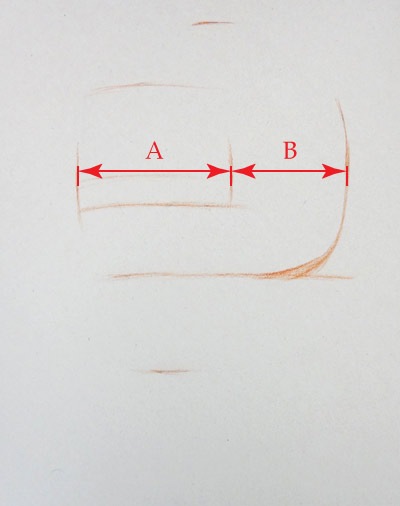 The countenance's edge is an important mark of the caput. This virtual line marks the head's planes, separating the face from the side of the head. This edge besides serves as a edge between tonal values of light and shade.
The eyebrow'southward edge location depends on the angle of view. It has to exist measured on the model by comparing distances "A" and "B".
Afterward, this edge will also help usa to determine the position of the ear.
7. Defining contours of the face
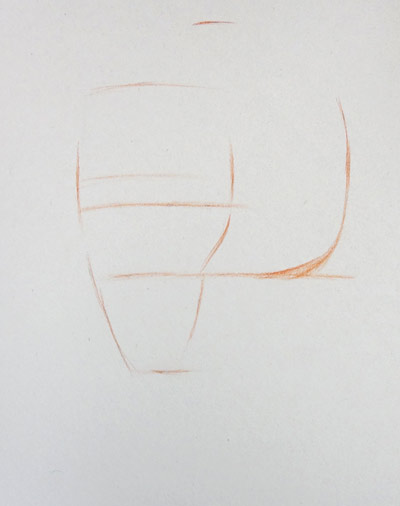 Contours of the face up are very important virtual lines that help to define portrait'southward likeness.
A contour should non be dislocated with an outline. In the drawing below, contours of cheekbones and jawlines are marked as contours. These lines are individual; angles of which take to be measured on the model. Contours hither describe the shape of the model'due south confront.
eight. Indicating the peak edge of the ear
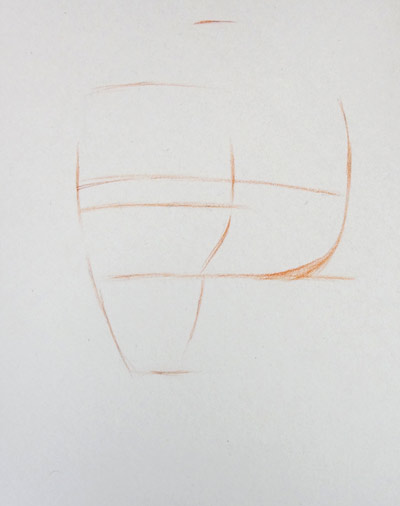 Different in previous step, where contours of the face up are individual, location of the superlative border of the ear is universal for all portraits. This edge is on the same level as the eyebrows line. To mark the top of the ear, we extend the eyebrows line horizontally towards backside of the head.
9. How to place the ear correctly
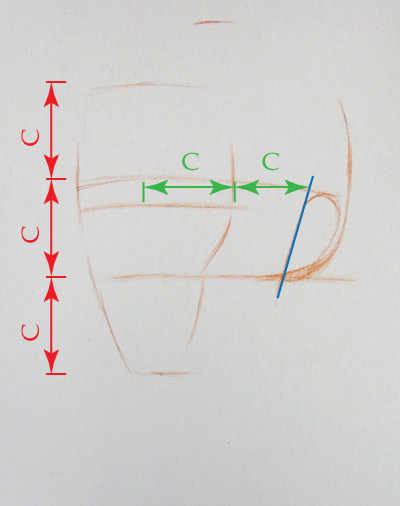 As the Cartoon Academy tutor, I often receive for critique portrait drawings that have one common fault – a miss-located ear. To avoid such a junior mistake you lot need to know the following rules:
- The summit of an ear is on the same level equally the line of eyebrows.
- The bottom edge of an ear is on the same level equally the base of the nose.
- The distances from the edge of the eyebrows to the ear and to the middle of the face are equal (marked past "C" in green). In perspective, these distances will be foreshortened. This is the aforementioned altitude as between the hair-roots and the eyebrows line, the eyebrows and the base of operations of the nose, and the base of operations of the olfactory organ and the mentum (marked past "C" in ruby-red).
- The line where an ear connects to the head is non vertical but tilted backward (blue line).
10. Placing the pit of the neck
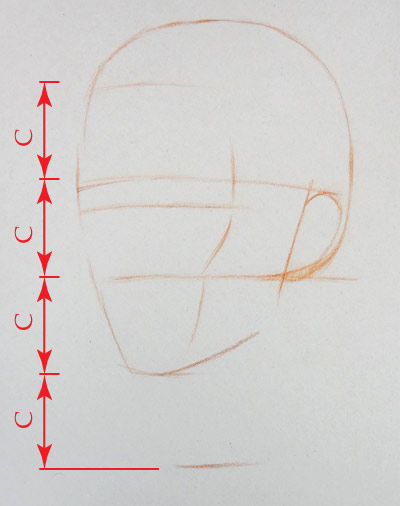 Another mutual mistake art students make is forgetting about the neck and drawing information technology as an afterthought when the caput is fully drawn. It is about impossible to draw believable looking portraits from life or imagination without the cognition of a head and shoulders anatomy.
Let's indicate an important landmark of the portrait – the pit of the neck. It is located betwixt 2 collarbones just above the breastbone.
The distance from the chin to the pit of the neck is equal to the ane-third proportion of the face (marked past "C" in red).
xi. Why sternocleidomastoid muscle is important in portrait drawing
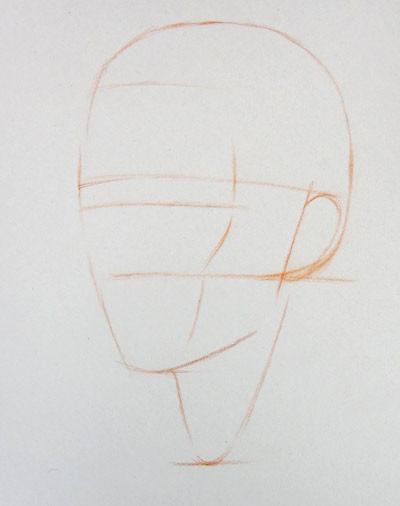 The musculus with a very long proper name, sternocleidomastoid, is an important landmark when information technology comes to drawing a neck. Information technology connects the elevation part of sternum (breastbone) and clavicle (collarbone) with the base of the skull called mastoid – the procedure of the skull positioned simply behind the ear.
Nosotros draw this muscle diagonally. In drawing, this musculus non just defines the shape of the cervix only also separates its frontal part from the side plane.
12. Trapezium
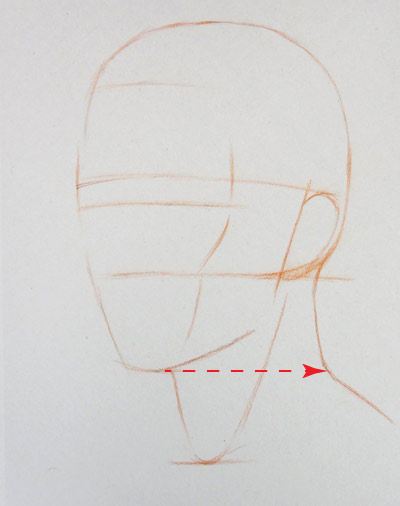 The trapezium is some other important musculus that defines the shape of the backside of the neck.
There is i bespeak yous need to ascertain when drawing a neck in the three quarters view – the place where the cervix changes into the bending of trapezium. This signal is on the same level as the bottom edge of the chin; see the dotted line on the drawing below.
13. Outlines of the neck and collarbones
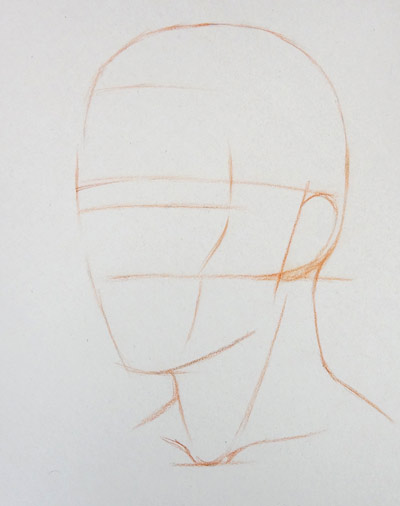 Following the constructive drawing principles, we depict not what we see, just what we know. This fully applies to collarbones, which can be covered by model'southward clothes.
In perspective, the axes of collarbones appear foreshortened and tilted. The pair of collarbones is curved like a cupid'due south bow or a stretched double "S". It connects the breastbone with the shoulder blades.
Outlines of the neck are individual and y'all have to observe its shape on the model.
It is a proficient approach to draw shoulders as ane continuous line from i shoulder to another, making sure they are on the same level and look natural.
fourteen. Drawing the base of operations of the cervix
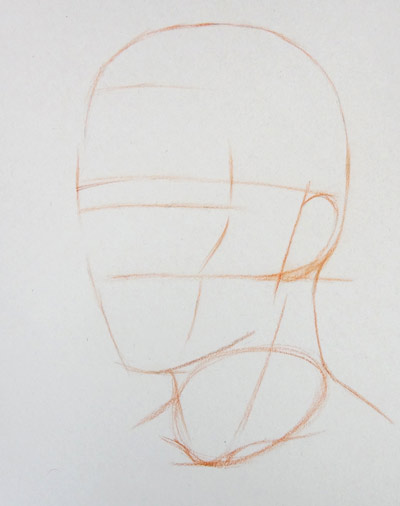 When main outlines and contours of the neck in place, we tin can mark the base of operations of the neck. It has a circular shape and in perspective appears equally a tilted oval. This oval goes through the acme pair of ribs and defines the width of the cervix at its base. This oval likewise marks the size of the top of the ribcage.
The base of operations of the cervix is an important contour considering information technology separates vertical planes of the neck from more horizontal surfaces of the shoulders. As such, information technology serves every bit a edge between calorie-free and shaded areas of those surfaces.
fifteen. Rendering the main shades of the portrait
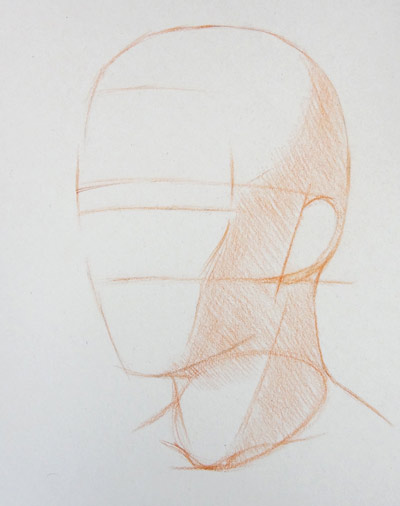 So far, we do not draw any facial features or small details. Instead, nosotros build a solid construction of the caput in drawing. This will help us to avoid mistakes and misplacements when information technology comes to drawing facial features. Cartoon eyes, mouth, nose, etc. at this stage is like decorating the walls earlier edifice a house.
Although this is a very full general outline of the head, it is a fourth dimension to block-in the principal shades of the portrait.
Use very light pencil pressure level to return shaded areas of the head and neck.
16. Drawing outlines of the countenance
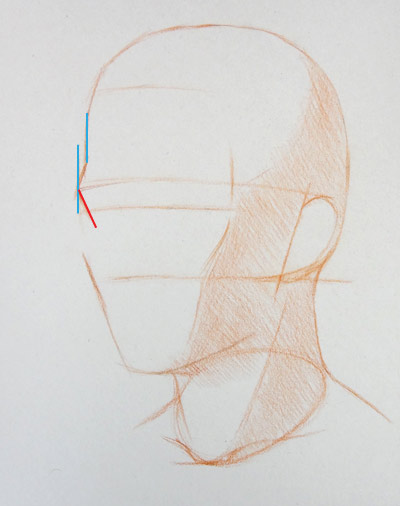 Check model'southward forehead and eyebrow outline – information technology will be individual to every person.
Notice how this outline is protruding in front of the forehead – this distance is indicated in blue lines on the cartoon below.
The eyebrow outline has its characteristic angle (marked in cherry-red lines).
17. Outlines of the cheekbone
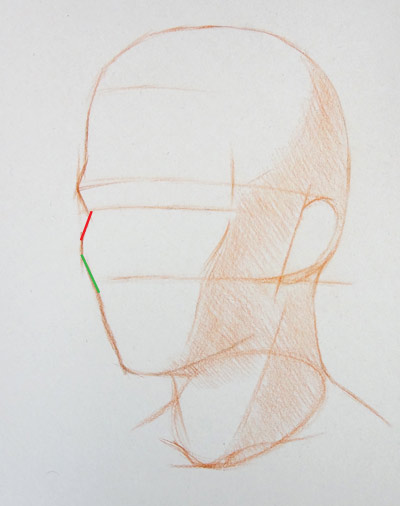 We move downward along the contour of the face, this time paying attention to the individual profile of the cheekbone.
In one case once again, check this outline on the model; pay attention how far it bends and compare to the outline of the eyebrow. Usually, the eyebrow would be extended forward a bit more than the outline of the cheekbone.
The eye socket outline depicted in the previous step continues downwards with the cheekbone outline.
You tin can also need to cheque the direction of the line that goes towards the jawbone (indicated in green on the cartoon below).
xviii. Parallel contours of the chin
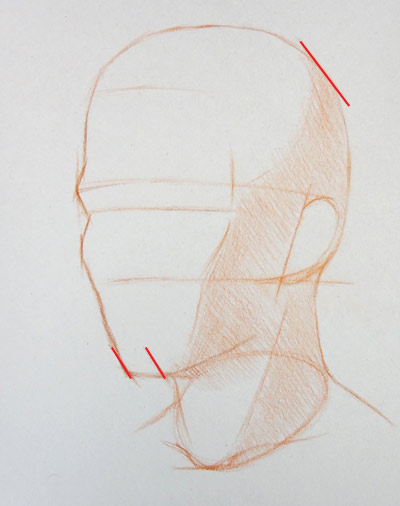 Usually, female chin is less pronounced than a male ane; nevertheless, both male and female jaws take characteristic direction of outlines that can be marked in two parallel lines, which are likewise parallel to the line of the dorsum of the head (marked in red).
nineteen. Cartoon the eyebrow curve
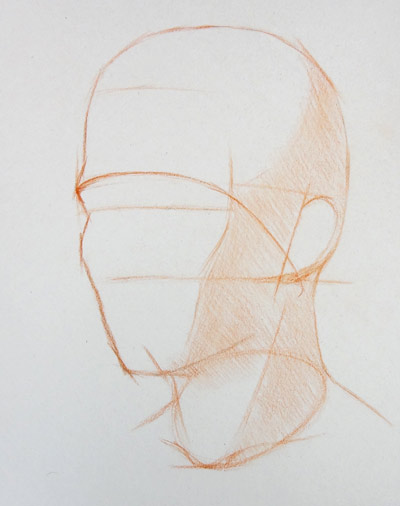 In a homo head, the border betwixt the cranial role of the skull, which protects the brain, and the facial function of the skull tin can be indicated by a curved virtual line that goes through the eyebrows and then sloped towards the ear channel.
This virtual curved line helps to build properly the bridge of eyebrows, which is not straight, merely aptitude downward.
20. Indicating the plane nether the eyebrows
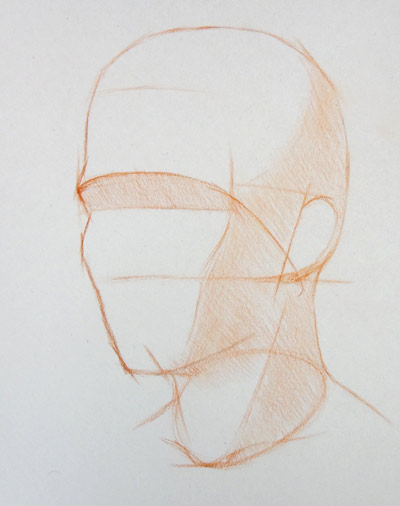 With the curved line of eyebrows divers, we tin caw block shaded expanse below it. In almost cases, the source of lite is above a model's caput, therefore it volition exist a shade under eyebrows. Then, we mark this shade in light tone applying very light pencil pressure.
As y'all see, we are even so defining big masses without any attending to facial features like eyes, nose and mouth. Drawing such facial features earlier the chief shape of the head is build proficiently is like decorating walls of a house that yet to be constructed. This sequence volition help you to ensure correct proportions of the portrait and volition result in greater likeness when we do the remainder of the portrait.
21. Defining the cheekbones bend
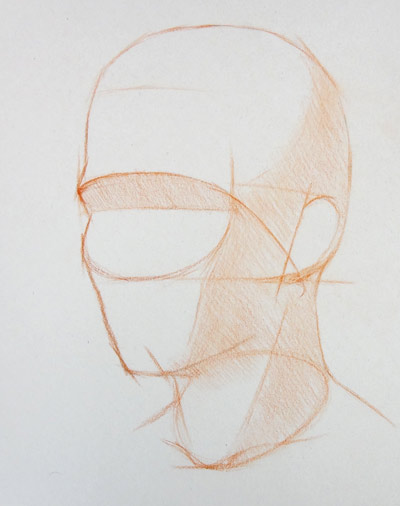 The cheekbones curve defines another important contour of the face. It bends downward from one cheekbone to another, with its lowest signal at the base of operations of the nose.
This virtual line is the border between the frontal role of the cheekbones and the upper jaw section.
A portrait artist can simply keep this line in listen rather than actually depict it. Nevertheless, equally a part of the head construction, this line helps to "build" the portrait geometrically right and proportionate.
22. Blocking the shade beneath the cheekbones' curve
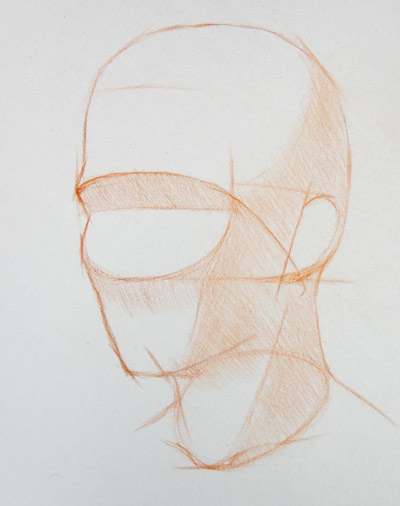 As mentioned before, the cheekbones curve separates two surfaces of the confront. The surface of cheekbones above that line is facing the source of light and therefore volition announced lighter than the surface below.
To indicate this difference in tonal values, nosotros shade in very low-cal pencil strokes the darker area right below the cheekbones curve.
There is no need to worry about verbal tonal value of this plane right at present. All we want from this step is to bear witness that 2 planes on both sides of the cheekbones bend accept different tonal values. Nosotros will fine-tune the verbal tonal values afterward on in this lesson.
23. Drawing the cardinal line of the face
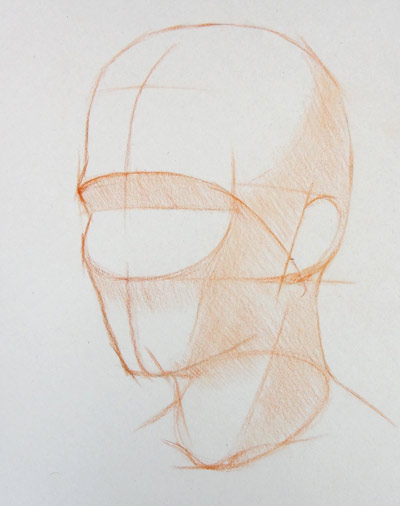 A virtual line that goes exactly in the middle of a face from the very summit of the forehead to the bottom of the chin is one of the almost of import landmarks of every human face. Information technology serves as the axis of symmetry and is used to residue all facial features at the same distances from that line.
Because the olfactory organ is located in front of this line, nosotros can pause the line or mark information technology very thinly within the olfactory organ area, so information technology would non interfere with lines of the nose later.
Many drawing books and tutorials suggest drawing a central line of the face much before in a portrait cartoon. The reason why we practise it now is because it is much easier, especially for beginners, to mark this line with precision when the overall structure of the caput is in identify.
I want to bespeak once over again that the sequence of steps is a personal preference and some artists practice not depict all virtual lines at all, keeping them in listen instead.
24. Marking contours of the eyebrows' corners
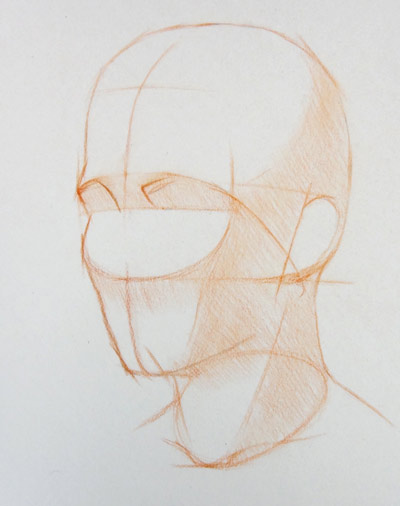 With the central facial line in place, we can go along by drawing smaller details making sure that facial features are symmetrical in relation to that line.
The shape of eyebrows is individual and y'all need to observe its character on the model first.
The bridge of the nose is bordering with the eyebrows corners, so we need to portray its width and angle.
25. Marking the upper eyelids' contours
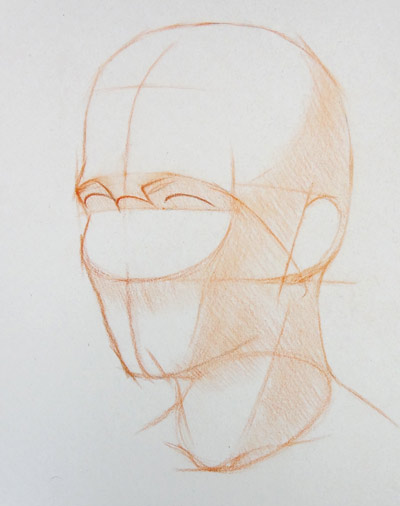 With the inner corners of eyebrows in place we can now mark the curvature of the bridge of the nose. This line is a helpful landmark, which usually coincides with the level of the upper eyelids contours. Considering every face is private, you need to cheque this level on the model and adjust the drawing if required.
Symmetrical features like eyelids accept to draw in pairs, making sure they are located on the same virtual horizontal line and have similar curvature. This helps to avert the error of drawing one centre higher or lower than the other.
26. Shading the area above the upper eyelids
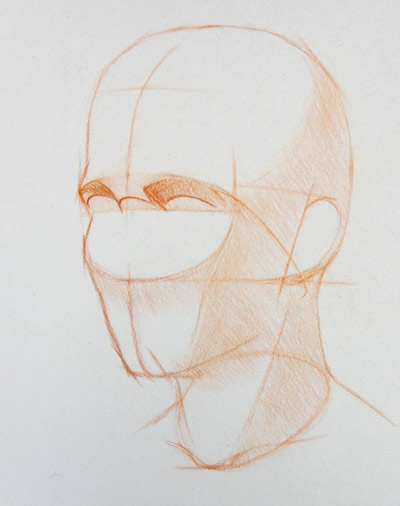 The expanse below eyebrows has darker tones than upper eyelids. And then, we could build up tonal values to block the expanse above the eyes.
Get light with rendering upper eyelids. Nosotros will come up back to darken these tonal values to required depth subsequently on. It is a good technique to build tones gradually. A proficient way of applying pencil strokes is forth object's contours. Also, if you are drawing in graphite pencil, smudging pencil marks is a large no-no. I will explain why later.
27. Marking the corners of the eyes
Depicting optics with precision is a critical step in portrait drawing. It is not an piece of cake job for beginners. I often receive portrait drawings for critique with optics that are as well close to each other or not symmetrical.
To pinpoint the verbal location of eyes in a portrait cartoon, you can use the post-obit rules:
- The distance between well-positioned eyes is equal to the length of one centre.
- Both eyes must be on the aforementioned level, which is the horizontal line that divides the height of the head in half.
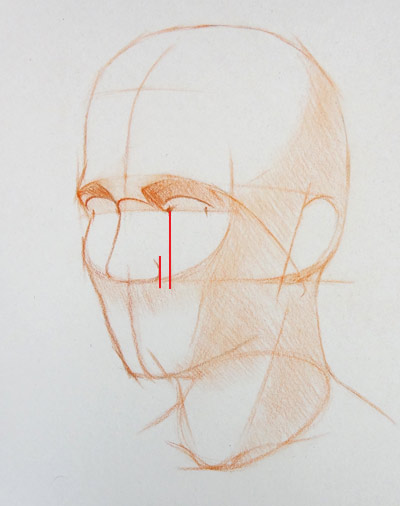 These rules are like shooting fish in a barrel to use when you lot draw a full-face straight view portrait. In our instance, it is a flake more complicated because the head is turned three-quarters and, therefore, is foreshortened in perspective. The eye-line is as well slightly curved in this view.
We begin with mark model left eye's corners. Check the distance from the primal line of the face to the eye's inner corner. Make sure, this corner is not besides close to the nose in your drawing.
When this inner corner of the centre is pinpointed with necessary precision, you can also mark the wing of the nose, which is slightly closer to the central line of the face. I marked the distance between the center'southward corner and the olfactory organ edge in blood-red lines.
Check the length of the eye on the model and marking it in cartoon.
Repeat this step for model's right eye. In the three-quarter view, the nose can overlap the inner corner of another eye. Draw this eye complete as if the nose is transparent.
28. Depicting eyelids
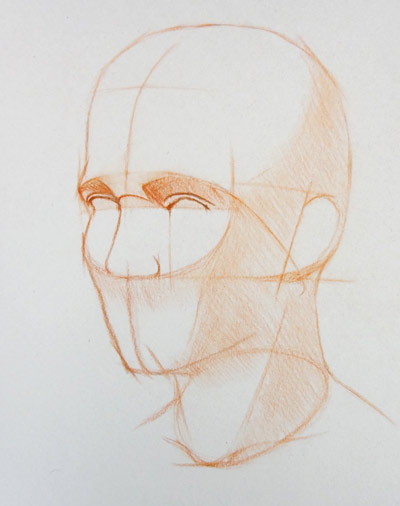 With all four corners of eyes in place, we tin can "build" eyelids with precision. I'm using the word "build" rather than "depict" because nosotros utilise constructive cartoon principles, drawing what we know instead of copying what we see. This is specially critical when portraying eyes.
An eye is a ball about one inch in bore and eyelids wrap around this ball. Despite an eyelid is a very thin muscle, it has certain thickness that has to exist depicted.
There is 1 rule you must know to draw eyelids skillfully – upper and lower eyelids are not symmetrical. The upper eyelid has its superlative signal i-third distance from the inner corner while the lower eyelid has the everyman point of its curve one-third from the outer corner of the middle. Avoid a junior mistake of drawing tuna-shaped symmetrical eyelids.
This rule is easier to follow in directly view portraits. In our case, the upper eyelid is foreshortened in perspective. However, the rule is withal in place.
29. How to Describe Optics
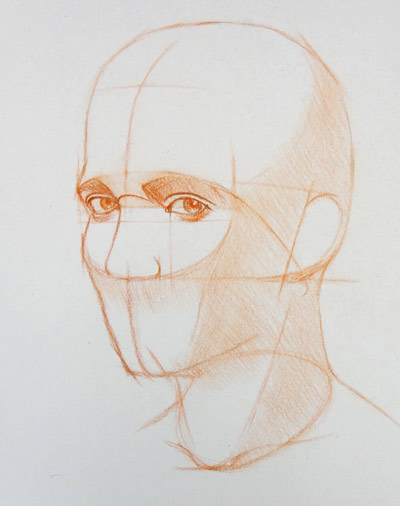 With eyelids depicted accurately, we tin place an iris of the centre. Hither's some other apprentice mistake y'all must avoid – placing an iris as a total circle symmetrically between the upper and lower eyelids. Unremarkably, the upper role of an iris is partially covered past the upper eyelid while information technology might be a small-scale gap between the lower border of the iris the lower eyelid.
You should also retrieve that the eyeball is not pure white and oft has darker tonal values than highlights of the forehead, for example. Also, in that location is a casted shadow under the upper eyelid.
Many art students ask me "how to depict eyelashes?" The professional way is not to depict individual eyelashes unless it is an advert drawing for mascara. 1 dark curved line would practise the chore. This is especially important for male portraits.
To learn more about how to draw eyes in this video lesson »
30. How to depict a olfactory organ
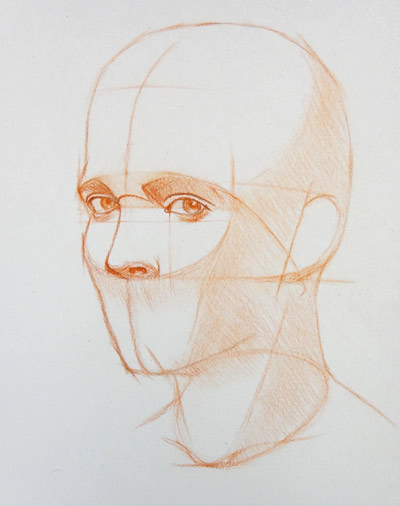 The shape of the nose can be simplified equally a prism. The base of the nose is already marked at the same level as the bottom edge of the ear and the bridge of the olfactory organ is curving between eyes. The width of the olfactory organ can be double-checked by comparing it to the distance between optics.
The individual shape of the nose has to exist observed on the model. Shapes can vary from person to person and capturing likeness depends on how accurately y'all "build" model's nose contours and outlines.
First, you can simplify nose contours as straight lines, depicting their angles and proportions. And then, yous tin shine-up lines with softer corners.
The lower plane of the nose is in shadow and its tonal value can be blocked in low-cal tones for now. We volition piece of work on tonal values with necessary depth later.
31. How to place a oral fissure correctly
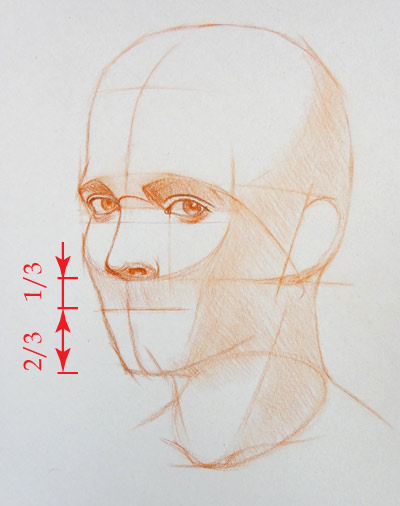 When drawing a mouth, there are some proportions you lot can you lot to place information technology correctly.
We begin with placing the line between lips. This line is located one-3rd from the base of the nose to the lesser of the chin. This is an platonic proportion in existent life it cad differ, so you lot can measure this altitude and adjust if required.
If you depict an open mouth, keep in mind that the lower border of the upper lip usually would be at the halfway point of the upper forepart teeth.
Of grade, when cartoon a portrait in the three-quarters view, the line betwixt lips will announced in perspective and might non be straight in your drawing.
32. Placing the lower lip
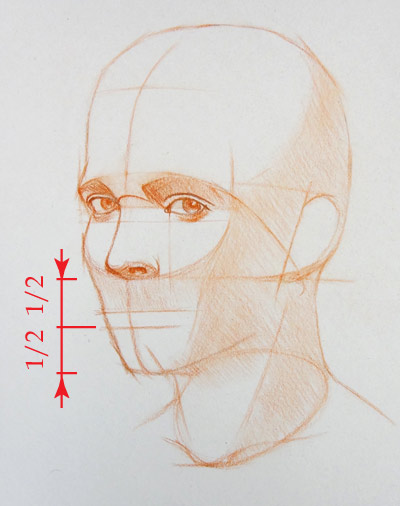 Information technology is quite easy to locate the bottom lip – its lower edge is exactly in the middle of the altitude from the base of operations of the nose to the bottom edge of the chin. This proportion is besides idealized and should be amended if your model is slightly different.
Avoid a junior mistake of placing the mouth exactly in the heart between the olfactory organ and the chin. Information technology is really located in the upper half of this altitude.
33. Marking the upper lip
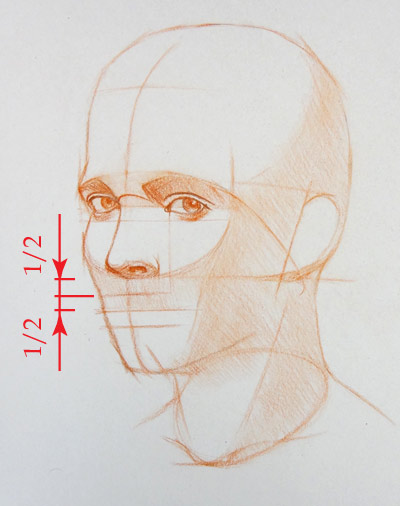 To locate the upper lip, merely divide the upper half of the distance from the nose to the mentum in half. In one case again, this line is marked according to classical proportions.
34. Blocking shades of the mouth
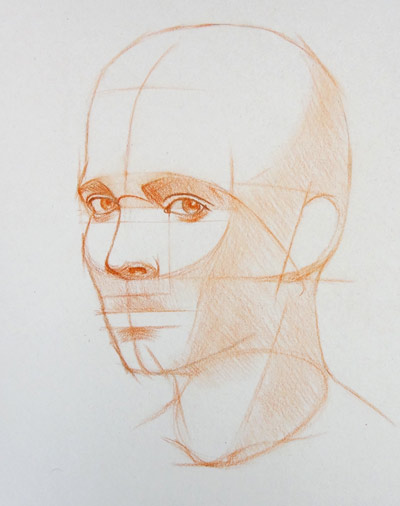 So far, we have iii parallel lines corresponding to the upper and lower edges of the mouth and the line between lips.
To indicate the form, we can slightly render shaded areas of the rima oris, which are the upper lip and the place below the lower lip.
At this step, nosotros simply differentiate planes of the mouth without going into details.
35. How to depict a mouth in a 3-quarter view
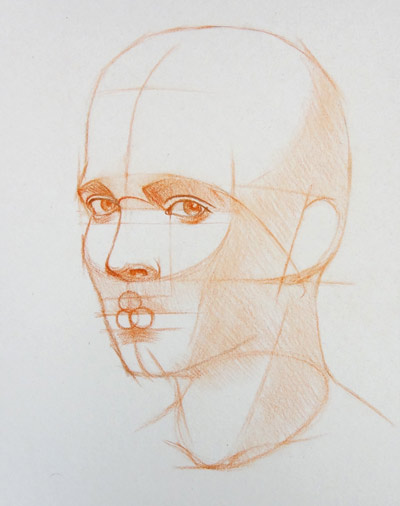 When it comes to depict a oral cavity in perspective, there are few things you demand to go along in listen. First of all, it is important to draw what you know – the construction of the mouth, rather than copy what you encounter – outlines of lips. Copying leads to inevitable junior mistakes.
Hither's what yous demand to know. The oral cavity'due south construction has a iii-dimensional nature. The upper and lower lips not simply curved equally a cupid's bow, resembling widespread characters "M" and "W", but also curved from front to back from the oral fissure center to edges. This presents a sure challenge in three-quarter drawing.
The one-half of the mouth that is further from the viewer volition be considerably foreshortened in perspective, while some other one-half volition exist visible in without foreshortening.
In that location is one uncomplicated way you can use to overcome a claiming of drawing a oral cavity. Draw three equal size assurance – 2 at the bottom and ane in a higher place them, all touching each other. These balls should be constructed in perspective, so one that is closer to the viewer might partially comprehend other balls. The upper ball sits in the middle of the upper lip and two lower balls correspond to the lesser lip.
To learn more, cheque this video lesson on how to depict a oral fissure »
36. Drawing the mouth's outlines
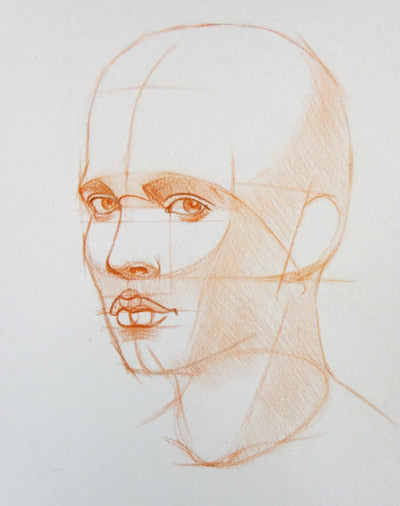 In previous step, nosotros put iii circles as the base of the lips – two balls for the lower lip and ane to a higher place them. At present, these balls can help united states of america to define the outlines of the mouth.
The top brawl coincides with the central part of the upper lip. The upper lip'due south groove divides this ball approximately in half.
The bottom outline of the lower lip goes effectually ii balls, and the line between lips curves effectually all three balls, resembling a cupid's bow.
37. Defining the contours of the oral cavity'south
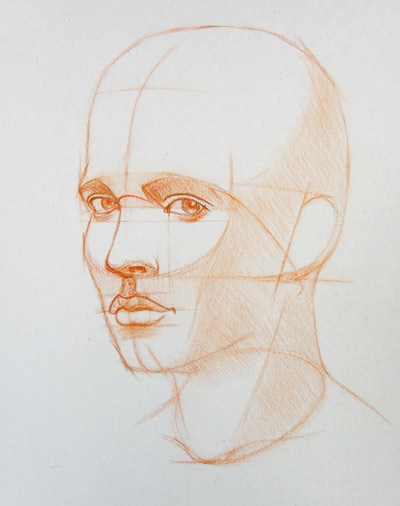 With main outlines of the moth in place, we can farther ascertain contours of the mouth. At his step, virtual balls of the oral cavity are redundant and can be erased birthday. This is the time to observe model's oral fissure shapes and depict its individual shape, trying to achieve the necessary likeness.
Make certain that the linear perspective is in place and the half of the mouth that is farther abroad from a viewer has more foreshortening than another half.
38. Virtual angles of the mouth
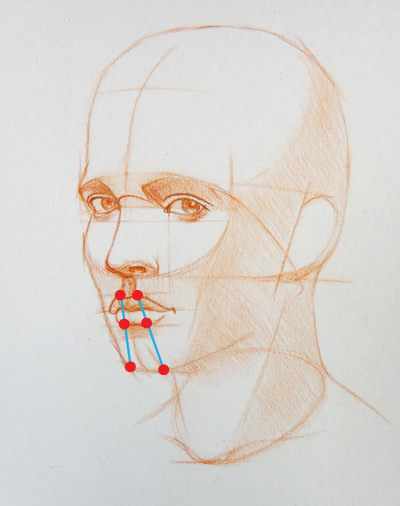 When defining the contour and outlines of the rima oris, yous tin double-check angles that usually follow this rule – the upper lip top points, continued with the lower lip bottom points grade 2 lines that go diagonally to the prominent points of the mentum. Every model has its individual shape of the mouth and chin, but in general, the upper lip protrudes more forrad than the lower lip and the lower lip protrudes more than the chin. This protrusion is usually forms a trapezium plane that is based on vi points of the chin and lips (marked with red dots).
You tin either draw those lines and dots or proceed them in heed.
39. How to depict an ear
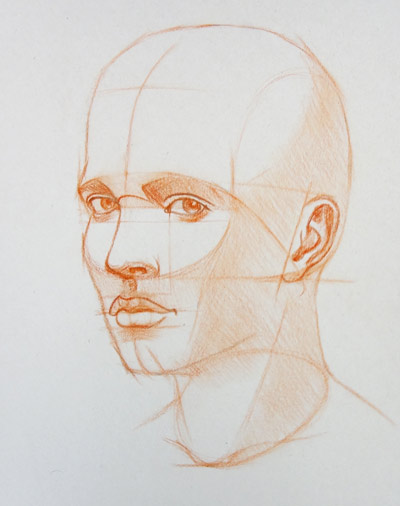 The ear's outline was marked a few steps earlier; it resembles the character "C." It's a skillful time to double-check its master proportion, which is the superlative of the ear is equal to the height of the nose or the distance betwixt the line of eyebrows and the base of the olfactory organ.
The ear's tiptop divided in half volition requite us a dimension of the ear'south width.
Further, nosotros can divide the height of the ear in three equal parts. Every part is as follows:
- At the peak, in that location is the antihelix, which is the outer rim of the ear.
- The middle third coincides with the concha – the ear'southward basin.
- And the lower office is taken by the lobule.
The curve of the antihelix is echoed by another rim that is located within and called the helix. At the top of the ear'southward bowl, the helix splits into two arms like the character "Y".
You will find more information on how to draw an ear in this video lesson »
40. Defining the side plane of the head
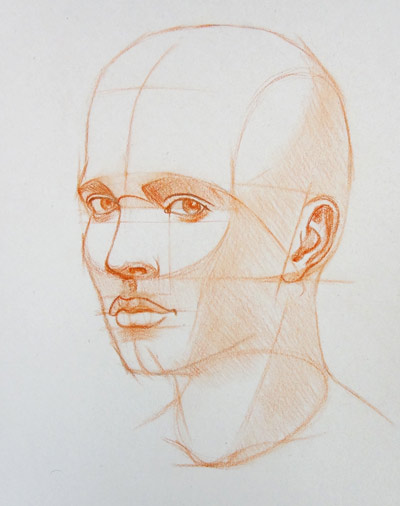 The curve where the forehead's plane changes into the side airplane of the head is an of import "landmark". Normally, at this edge tonal values will change from light to darker tones. This border can be marked earlier in drawing and now we tin double-check its location and employ light tonal shades to differentiate planes of the caput.
41. Shading the temple
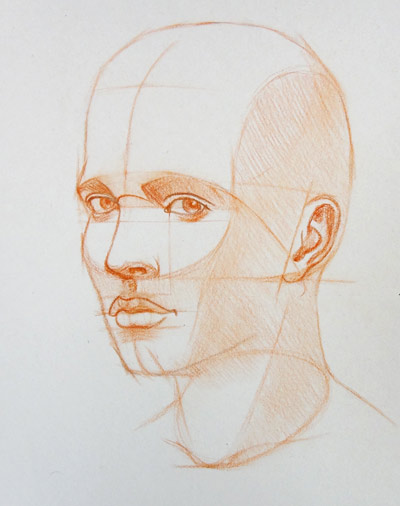 To separate the airplane of the temporal os, we can shade its tonal value using broad strokes with low-cal pencil pressure.
The direction of the strokes tin get contours of that plane to emphasize its spatial position. There's no need to stop this part in one become, we volition come dorsum to it later to deepen the tonal values as required.
42. How to draw a hairstyle
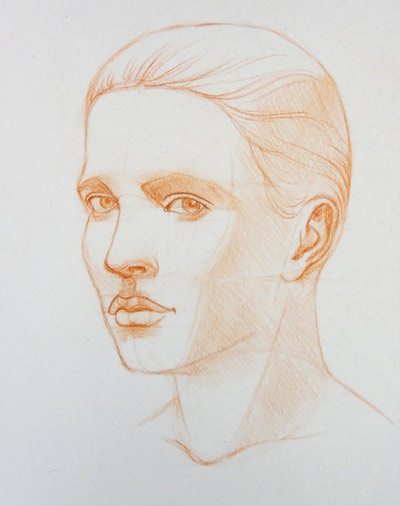 Up to this stride, I've intentionally left the hairstyle untouched to demonstrate the planes and construction of the model's head. Drawing a bold head is non required and you tin indicate the pilus book much earlier in the drawing.
Students often ask me how to draw hairs. At that place are several points to keep in mind:
- Depict a hairstyle not every bit individual hairs, only every bit one large mass.
- Construct planes of the hairstyle.
- Avert rendering individual curls in the beginning. Details will come afterwards.
- Utilize pencil strokes along hairstyle contours, Exercise not doodle randomly.
- Render a hairstyle gradually; do not complete information technology before other parts of the portrait.
You will observe much more information on how to draw pilus here »
43. How to render tonal values
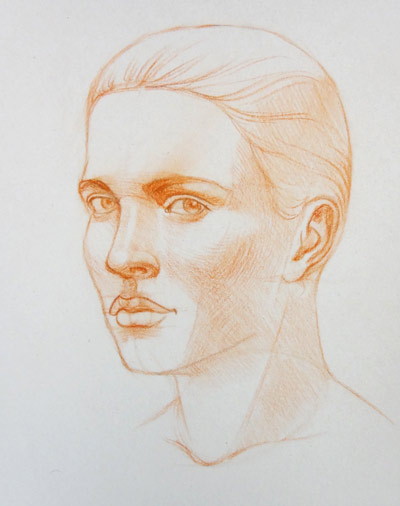 There are many approaches to rendering tonal values. Here, I will describe the classical way:
- Information technology is meliorate to showtime from rendering big areas with the darkest tonal values.
- The process can develop gradually in multiple layers.
- The aim is to keep the cartoon getting darker simultaneously in all places without terminate ane expanse before others.
- While shading, you need to go along an eye on relative values, comparing dissimilar areas to each other.
- When drawing in graphite pencil, the pencil tip should be sharp at all times.
- Avert going the full strength a drawing tool tin can provide from the beginning.
- Use pencil strokes forth the contours of objects.
- Reveal the volume of an object with strokes.
- Avoid 90-caste cantankerous-hatching unless you depict a drapery.
- Keep the gamut of pencil strokes rich and wide – utilise various directions of strokes, pencil pressure, curvature and length of lines.
At that place are many more tips and professional person demonstrations on how to return tonal values presented in the Cartoon Academy video lessons »
44. Drawing small details
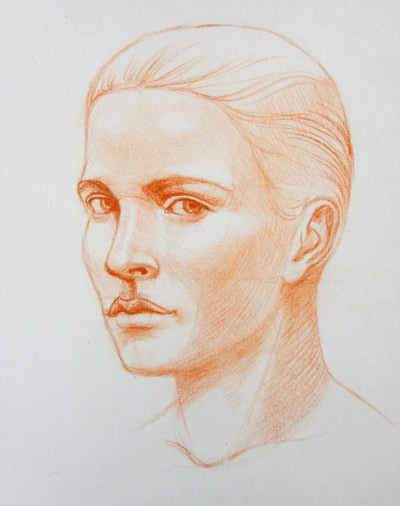 Working on a drawing goes from big areas to minor details.
When working on smaller details, it is tempting to finish some places earlier the rest of the cartoon. Professional artist keeps the whole cartoon complete, but not finished at all times until 1 decides that the creative chore is achieved.
Smaller details in a portrait are shaded using the aforementioned rules of rendering tonal values as when shading big areas; still, shorter pencil strokes are required for such chore.
The skilful way of working on a portrait is when drawing goes from large areas to small-scale details and then back to big areas once over again. Such bike can exist repeated several times. This will ensure that a portrait looks unified however detailed.
45. When to finish a head drawing
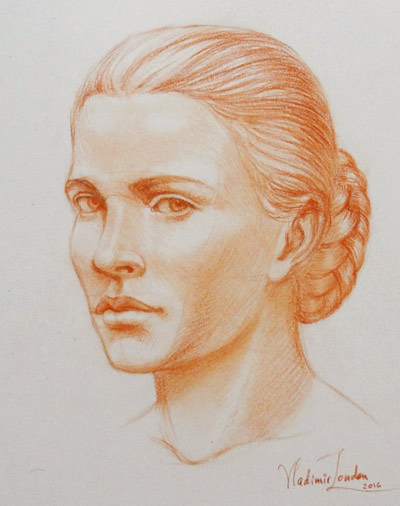 The beauty of working on a portrait rendering it gradually is that it would look completed at all times. So, it is your conclusion as an creative person when to finish it. However, if you leave the drawing slightly unfinished, it would announced more interesting to a viewer. Overworking a cartoon is less desirable than stopping only before you think it is done.
Conclusion
I hope this information on how to draw a portrait was helpful. This is just i way of cartoon a portrait from many that are described in the Drawing Academy class. If yous want to larn more, enroll in the Drawing Academy course »
If yous accept whatever questions, you lot can ask Drawing Academy tutors online: //drawingacademy.com/drawing/inquire-tutors-questions
I wish you all the creative success you deserve.
Vladimir London
Drawing University tutor and founder
About the Author
Vladimir London is the internationally published writer of several art books and the founder and tutor of Drawing University – the online video course where you tin can larn how to draw any you see, think or imagine, using traditional cartoon techniques.
He is also a creator of the Anatomy Master Class – //AnatomyMasterClass.com – the video course for fine artists who want to learn fast all you need to know almost how to describe human figures and portraits with the necessary knowledge of man body, head and face anatomy and proportions.
Vladimir, together with Natalie Richy, fine artist and teacher, is also a co-founder of the Web Art University – //WebArtAcademy.com – the online video course that teaches traditional oil painting techniques.
To acquire how to draw whatever y'all see or imagine,
Enroll in the Drawing Academy Course:
Pay for the form in three easy installments
- Receive xv new videos monthly (45 in total)
- Incredible discount – $4,164
- Bonuses - Fine Art eBooks and Videos
- Drawing Academy Diploma of Excellence after course completion in 3 months
- Personal coaching by Drawing Academy Tutors
- Lifetime membership. Costless after the 3rd month
Total cost: $291 (iii $97 installments)

Get all video lessons for a quondam payment
- Firsthand access to all 45 video lessons
- Incredible discount – $4,198
- Bonuses - Fine art eBooks and Videos
- Cartoon Academy Diploma of Excellence afterwards class completion in 3 months
- Personal coaching past Drawing Academy Tutors
- Lifetime membership. No more payments
Total cost - Only $257

Source: https://drawingacademy.com/how-to-draw-a-portrait
Posted by: laliberteflooke42.blogspot.com
0 Response to "How To Draw A Portrait Of Someone"
Post a Comment