

What Are Examples Of Performance Locomotion, Growth, Genetic Makeup
Gene doping could stretch the physical limits of human strength and endurance. What are the consequences of factor therapy in sports competition, and more, importantly, is it safety?
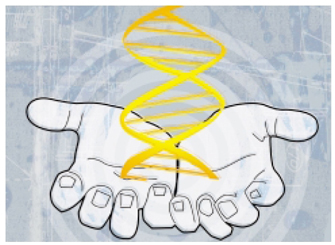
Cistron doping.
© 2003 Nature Publishing Grouping Murray, T. An Olympic tail? Nature Reviews Genetics 4, 494 (2003). All rights reserved. 
Gene doping is an outgrowth of gene therapy. However, instead of injecting Deoxyribonucleic acid into a person's body for the purpose of restoring some function related to a damaged or missing cistron, as in gene therapy, factor doping involves inserting Dna for the purpose of enhancing able-bodied performance. The World Anti-Doping Agency (WADA), an international system created in 1999 to "promote, coordinate, and monitor the fight against doping in sport in all its forms," defines gene doping every bit the "nontherapeutic use of cells, genes, genetic elements, or modulation of cistron expression, having the capacity to raise functioning" (World Anti-Doping Bureau, 2008).
Ane of the first issues that comes up when because whether, when, and how results from genetic studies will be exploited for gene doping purposes is whether factor doping is "correct." While many people concord with WADA's position that gene doping threatens the integrity of sports contest, others think differently. For instance, Julian Savulescu, professor of ethics at the University of Oxford, England, argues that "[g]enetic enhancement is not confronting the spirit of sport; it is the spirit of sport" (Skipper, 2004). Whether or not it is right to utilize Deoxyribonucleic acid for enhanced athletic operation volition probable be a bailiwick of fiery debate for years to come.
The Science Behind Factor Doping
While gene doping has even so to go a reality, H. Lee Sweeney, a professor of physiology at the University of Pennsylvania School of Medicine and one of the leading researchers in the field of gene therapy, has already been inundated with requests for such doping from professional weight lifters and numerous other athletes, according to an article in Science News (Brownlee, 2004). Sweeney has garnered this attention considering of his discovery of a style to potentially opposite muscle degeneration caused past diseases like Duchenne muscular dystrophy (DMD), a sexual activity-linked genetic disorder. In patients with DMD, a disquisitional muscle poly peptide called dystrophin gradually becomes dysfunctional over the get-go few years of an afflicted person'south life, leading to a loss of muscle fiber, an increase in fibrosis, and eventually complete loss of muscle function. Working with a mouse breed that had a mutation in the dystrophin gene and thus displayed a DMD-like phenotype (mdx mice), Sweeney and his colleagues observed that when a protein called insulin-like growth gene 1 (IGF-1) interacted with the cells on the exterior of muscle fibers, it caused the cells to grow. In addition, the research team determined that inserting the gene that encodes IGF-1 into muscle cells produced the same result.
Sweeney and his colleagues farther plant that when the muscle fibers of mdx mice were exposed to IGF-i, not but did fibrosis decrease every bit the mice aged, merely muscle mass actually increased past almost 40% (Barton et al., 2002). Sweeney told Science News that when the mice became the equivalent of senior citizens (which for mice is near 20 months of age), they were still as strong and fast as they had been when they were young. Later on these and subsequent studies, the IGF-1-endowed mice became known as "Schwarzenegger mice." While groundbreaking, Sweeney's research is nevertheless experimental, and the findings have yet to exist tested on DMD patients or other humans.
Meanwhile, a group of scientists headed by Ronald Evans of the Salk Institute in La Jolla, California, demonstrated that injecting mice with the gene that encodes a fatty-burning protein called PPAR-δ enabled the animals to sew together to twice the distance of their wild-type littermates (Wang et al., 2004). Although genetic technology of these then-chosen "marathon mice" could potentially exist exploited to enhance athletic performance (in long-distance runners or swimmers, for example), Evans's reason for pursuing this line of research was to see whether it might have therapeutic value. Specifically, he wanted to test whether increasing PPAR-δ expression would transform muscle fibers in a mode that might protect against obesity and type 2 diabetes, equally previous studies had shown that many obese and type Two diabetic patients take fewer type 1 muscle fibers. Evans and his squad thus determined that increasing PPAR-δ expression effectively increased the number of type 1 musculus fibers in mice.
Would Gene Doping Be Safe?
More important than the ethical implications of gene doping, some experts say, is the fact that factor doping could be dangerous, and perhaps even fatal. Consider the protein erythropoietin (EPO), a hormone that plays a key role in cerise claret cell product. EPO is ofttimes administered (equally a hormone, not via gene therapy) to patients suffering from anemia as a event of kidney failure or chemotherapy. Scientists are hopeful that they tin someday develop a factor therapy method of delivering the factor for EPO instead of administering the poly peptide itself. The hormone EPO is also used equally a highly controversial operation-enhancing substance by athletes equally a style to optimize oxygen commitment to muscle cells (by increasing the number of red claret cells). Like IGF-one and PPAR-δ, the EPO factor is considered by some experts to exist a potential candidate for gene doping (Azzazy et al., 2005).
But scientists notwithstanding have much work to attain before EPO cistron delivery, whether for the purpose of gene therapy or the more controversial purpose of factor doping, is considered safety. In the aforementioned Science News article, the reporter relays a story by Jim Wilson, a professor of medicine at the University of Pennsylvania and a leading researcher in the field of gene therapy. When Wilson and colleagues injected macaque monkeys with viral vectors carrying the EPO gene, the host cells ended upward producing and so many red claret cells that the macaques' blood initially thickened into a deadly sludge. The scientists had to depict claret at regular intervals to keep the animals alive. Over time, as the animals' immune systems kicked in, the state of affairs reversed and the animals became severely anemic (Rivera et al., 2005).
The field of gene therapy, and by extension, gene doping, is full of unpredictable and dangerous results like this, which is why Sweeney, Evans, and other researchers who accept identified Deoxyribonucleic acid targets that could potentially be exploited for cistron doping are the first to emphasize that the research is still at only an experimental stage. The therapies need to be proven safety in some of the larger animal models, not merely mice, before they can even be tested in humans, let alone used for therapy or, as Savulescu says, "in the spirit of sport."
References and Recommended Reading
Azzazy, H. M. E., et al. Doping in the recombinant era: Strategies and counterstrategies. Clinical Biochemistry 38, 959–965 (2005)
Barton, E. R., et al. Muscle-specific expression of insulin-like growth factor ane counters musculus pass up in mdx mice. Periodical of Cell Biology 157, 137–148 (2002)
Brownlee, C. Cistron doping: Volition athletes go for the ultimate high? Science News 166, 280 (2004)
Murray, T. An Olympic tail? Nature Review Genetics 4, 494 (2003) doi:x.1038/nrg1135 (link to article)
Rivera, V. M., et al. Long-term pharmacologically regulated expression of erythropoietin in patients post-obit AAV-mediated gene transfer. Claret 105, 1424–1430 (2005)
Skipper, 1000. Cistron doping: A new threat for the Olympics? Nature Reviews Genetics 5, 720 (2004) doi:x.1038/nrg1461 (link to article)
Wang, Y. X., et al. Regulation of muscle fiber type and running endurance by PPAR-δ. PLoS Biological science ii, e294 (2004) (link to article)
World Anti-Doping Agency Abode Page. (accessed June 27, 2008).
Source: http://www.nature.com/scitable/topicpage/sports-gene-doping-and-wada-764
Posted by: laliberteflooke42.blogspot.com
0 Response to "What Are Examples Of Performance Locomotion, Growth, Genetic Makeup"
Post a Comment